Fuzzy logic - Logical blurred and blurred control
Introduction
The blurred logic (Fuzzy Logic) has arisen like a lucrative tool for the control from subsystems and complex industrial processes, as well as for the electronics of entertainment and home, systems of diagnosis and other expert systems. Although the blurred logic invented in United States the fast growth of this technology has begun from Japan and now it has reached the USA and also Europe again. The blurred logic is still a boom in Japan, the number of letters patenting applications increases exponentially. Mainly one is simple applications rather of blurred logic.The blurred thing has gotten to be a key word to sell. Blurred the electronic articles without componetes are remaining out of phase gradually. Like a jaw, that shows the popularity of the blurred logic, every time is more frequent a seal with "fuzzy logic" printed on the product.
In Japan the investigation on blurred logic is supported widely with an enormous budget. In Europe and the USA efforts are being made to reach to the tremendous Japanese success. For example, the NASA uses blurred logic for the complex process of connection maneuvers.
The blurred logic is basically an multievaluated logic that allows intermediate values to be able to define conventional evaluations like sí/no, verdadero/falso, negro/blanco, etc. The slight knowledge as "rather it warms up" or "little cold" can process be formulated mathematically and to be by computers. Of this form an attempt has been made to apply one more a more human form to think about the programming of computers. The blurred logic began in 1965 by Lotfi To Zadeh, professor of science of computers in the University of California in Berkeley.
What is a blurred set?
The most basic notion of blurred systems is (sub)conjunto blurred.Let us see an example:
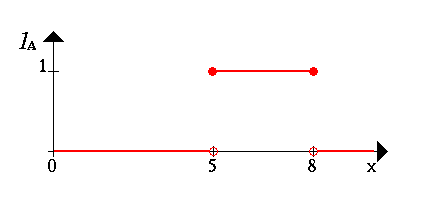
In the first place we considered a set X with all the real numbers between 0 and 10 that we called the speech universe. Now, we defined a subgroup To of X with all real numbers in the rank between 5 and 8.
Now we showed the set by its characteristic function, is to say this function assigns a number 1 or 0 to the element in X, depending on if the element is in the subgroup To or no. This entails to the following figure:
This concept is sufficient for many areas of application. But we can find situations easily where he lacks flexibility. In order to include/understand this concept we see an example:
We want to describe the set of young people. More formally we can denote
As - in general - the age begins in 0, the most inferior rank of this set is clear. The superior rank, on the other hand, is rather complicated to define. As a first attempt we placed the superiora rank in, we say, 20 years. Therefore we defined B like a denominated interval:
Now the question is: why somebody is in its 20 young birthdays and on the following day no? Obvious, this it is a structural problem, because if we move the limit superior of the rank from 20 to an arbitrary point we can raise the same question.
One more a more natural way to construct the joint B would be in smoothing to the strict separation between the young person and the nonyoung one. We will make this to allow not only (irritated) to the decision "él/ella IF he is in the set of young people" or "él/ella is not in the set of young people", but also the most flexible phrases like "él/ella IF the young people set of" or "él/ella belong just a little bit more to do not belong approximately to the set of young people".
We happened next to show as a blurred set allows us to define a notion as "él/ella is a little young".
So and as we stated in the introduction we can use blurred sets to make computers wiser, and now we must codify the idea more formally. In our example first we codified all the elements of the Universe of Speech with 0 or 1. A way to generalize this concept is in allowing more values between 0 and 1. In fact, we allowed infinite alternatives between 0 and 1, denominating the unit interval I = [ 0, 1 ].
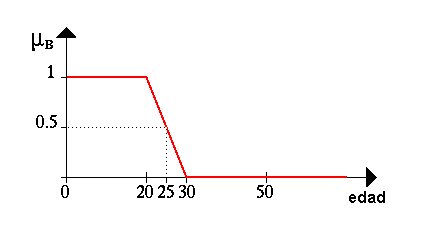
The interpretation of the numbers now assigned to all the elements of the Universe of Speech is something more difficult. Of course, number 1 assigned to an element means that the element is in the joint B and 0 means that the element is not definitively in the set the B. The rest of values means a gradual property to the joint B.
To be more concrete we now showed graphically the set of young people of form similar to our first example by its characteristic function.
Now we know what is a blurred set. But what can be done with him?
Operations with blurred sets
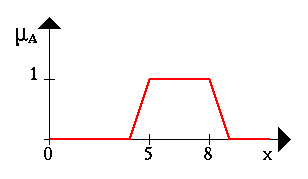
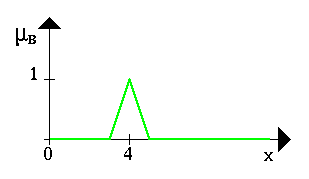
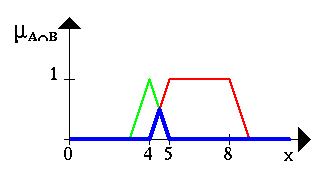
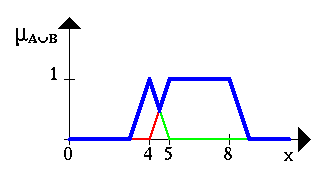
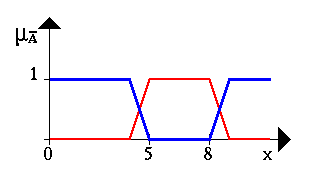
Now that we have an idea of which they are joint blurred, we can introduce the basic operations on blurred sets. Seemed to the operations on boolean sets we can intersection , unify and also deny blurred sets. In their first article on blurred sets, L. To Zadeh suggested the minimum operator for the intersection and the maximum operator for the union of two blurred sets. It is easy to see that these operators agree with the boolean unification, and intersection if we considered the degrees solely members 0 and 1.In order to clarify this, we will show several examples. Be At a blurred interval between 5 and 8, and B a blurred number surroundings to 4. The corresponding figures are next:
The blurred control
The blurred controllers are the most important applications of the blurred theory. They work of a form quite different from the conventional controllers; the expert knowledge is used instead of equations differentials to describe a system. This knowledge can be expressed of a very natural way, using the lingüísticas variables that are described by means of blurred sets.Example: The inverted pendulum
The problem is in balancing a pole on a movable platform that can move in two only directions, to the left or the right. First of all, we must define (subjectively) as is the speed of walk: discharge, low, etc. This is made to specify the functions pertaining to the blurred set:
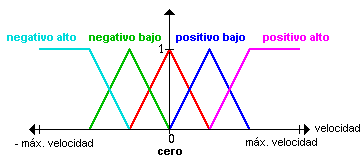
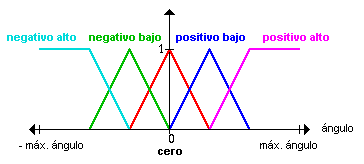
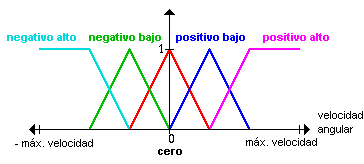
Now we will give several rules that say what to do in concrete situations:
The pole considers for example that is in the central position (the angle is zero) and it does not move (the angular velocity is zero). Obvious this is the wished situation, and therefore we do not have to do nothing (the speed is zero).
Let us consider another case: the pole is in the central position like before, but it is in movement at low speed in the positive direction. Naturally we would have to compensate the movement of the pole moving the platform in the same direction of low speed.
Of this form we have constituted two rules that can be put in one more a formalized form like this:
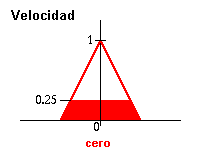
If the angle is zero and the angular velocity is the zero then speed will be zero.
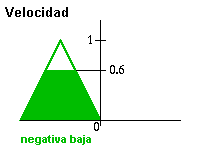
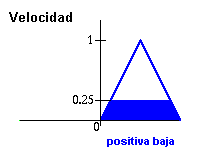
If the angle is zero and the angular velocity is positive low then the speed will be positive low.
We can summarize all the applicable rules in a table:
| angulo | quick | NA NB C PB PA ----------+------------------------------ v NA | NA. NB | NB C to C | NA NB C PB PA n PB | C PB g PA | PAwhere NA is one (usual) abbreviation for high refusal, NB for negative loss, etc.
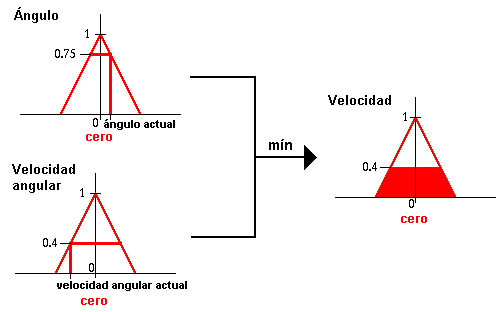
Next we will show as these rules can be applied with concrete values for the angle and angular velocity. For it we are going to define two explicit values for the angle and the angular velocity to operate with them.
Let us consider the situation following:
A present value for the angle:
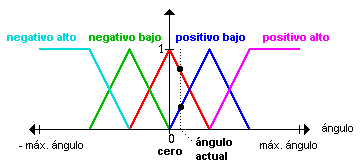
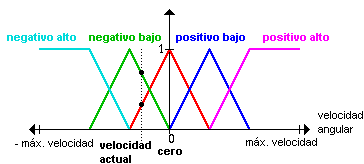
If the angle is zero and the angular velocity is the zero then speed will be zero.
to the values that we have defined.
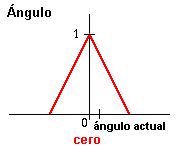
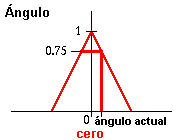
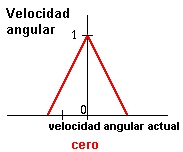
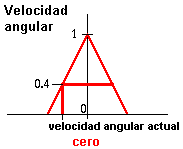
This is the linguistic variable "angle" where we were centered in set "zero" and the present angle:
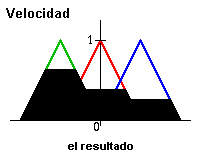
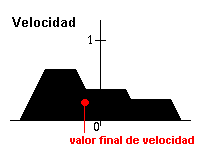
Applications of the blurred logic
Mainly, we will watch the aptitude of the blurred control in general terms.The use of the blurred control is recommendable:
Conclusion
This concludes our brief course on blurred logic and blurred control. We hoped that it enjoys it and that the explanations are of some aid for you.Definitions
Intersection of SetsWe called a new set generated from two determined sets To and B, intersection of A and B, if the new set exactly contains those elements that are contained in A and B.
Unification of Sets
We called a new set generated from two determined sets To and B, unification of A and B, if the new set contains all the elements that are contained in A or B or both.
Negation of Sets
We denominated to the new set that containing all the elements that are in the universe of speech but not in the set To the negation of A.
Lingüísticas variables
A linguistic variable is a quintuple (X, t(x), or, g, m), where X is the name of the variable, T(X) is the joint term (that is to say, the set of names of linguistic values of X), Or is the speech universe, G is the grammar to generate the names and M is a set of semantic rules to associate each X with their meaning.
PRINCIPALELECTRÓNICA INFORMÁTICA TECNOLOGÍA www.cienciasmisticas.com.ar- El sitio de electrónica, informática y tecnología.
 |
 |
 |
 |
||
| Ciencias Místicas - | |||||